

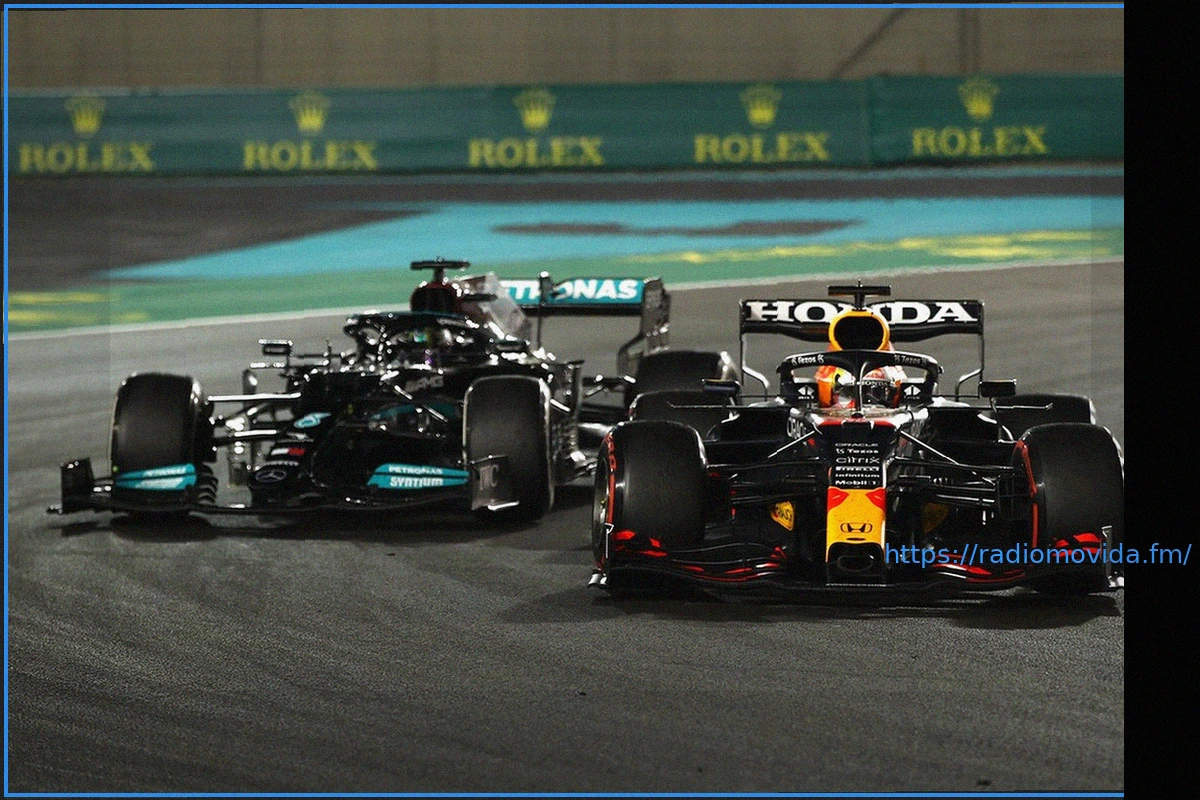
A former colleague from the FIA has strongly defended Michael Masi’s decisions during the controversial 2021 Abu Dhabi Grand Prix, suggesting that Masi was unfairly made a ‘scapegoat’ after being removed from his position.
With only five laps remaining in the intense championship battle between Lewis Hamilton and Max Verstappen, Nicholas Latifi’s crash triggered a safety car. Verstappen seized the opportunity to pit for fresh soft tires, while Hamilton remained on worn hard tires. Crucially, five lapped cars were positioned between the two rivals. Initially, the FIA indicated these cars would not be allowed to unlap themselves, but Masi later reversed this decision, allowing only those five cars to lap themselves before the end of lap 57. This maneuver set up a final lap restart, as per safety car regulations, under which overtaking is not permitted until racing resumes.
Ultimately, Verstappen overtook Hamilton on the final lap to secure the race win and the 2021 world championship. Mercedes immediately lodged protests with the stewards regarding the race’s conclusion, though these were eventually withdrawn.
An FIA investigation identified ‘human error’ as the cause of Masi’s actions, leading to his dismissal as race director before the 2022 season, with Verstappen’s title remaining intact.
However, Niels Wittich, who served as Masi’s deputy and later replaced him (initially in a two-man structure with Eduardo Freitas before becoming sole director), believes his former boss “didn’t do that much wrong” and was indeed made a scapegoat. Wittich, who himself was later removed as race director before the 2024 Las Vegas GP, told Formel1.De in Germany:
“From my point of view, Michael didn’t do that much wrong. The regulations didn’t strictly define everything. What he did was within his authority. He had a certain level of discretion in how to deploy the safety car.”
Wittich highlighted a key agreement among teams, the FIA, and Formula 1: to strive for races to finish under green flag conditions whenever possible, avoiding an anti-climactic ending behind the safety car.
“One key factor was that teams, FIA, and Formula 1 had all agreed – over many meetings – that races should, if possible, finish under green flag conditions. Nobody wanted a race ending behind the safety car,” he explained.
Wittich further elaborated on the difficult choices Masi faced: “In Abu Dhabi, the situation was such that any intervention would have disadvantaged someone. You could have red-flagged the race, but that requires specific conditions like danger to personnel or a blocked track. That wasn’t the case. So, a red flag wasn’t really an option.”
Addressing the controversial decision regarding the lapped cars, Wittich stated: “Then came the lapped cars question. Initially, he said they wouldn’t unlap themselves, then he allowed it, but modified the usual procedure by not waiting an extra lap. That was within his authority under the regulations at the time.”
He believes Masi fulfilled the collective desire for a racing conclusion: “He essentially did what everyone had agreed upon: create one final racing lap. It produced a spectacular finish, an overtake, a winner and a runner-up. It could have gone the other way just as easily. That’s sport.”
Wittich acknowledged the inherent controversy of late safety cars: “A late safety car is always controversial. Fans don’t like it if it decides the race, but that applies everywhere. Whether it’s lap one or the final laps, someone gains, someone loses. That’s part of the sport.”
He noted that the race itself was largely uneventful until Latifi’s crash, which “suddenly became decisive.” Wittich countered post-race critiques about alternative decisions, emphasizing consistency: “People later said: ‘You could have red-flagged it, you could have done this or that.’ Yes, you could, but those would have been inconsistent decisions compared to earlier races. And consistency is key.”
Recalling meetings with teams in early 2022, Wittich stated: “In meetings with the teams in early 2022, I asked them directly: ‘Do you want us to red-flag every minor incident?’ They said no. ‘Do you want different rules for the final race?’ Again, no.”
He also emphasized that a championship is not solely decided by one race: “A championship isn’t decided in one race alone. Points lost earlier in the season matter just as much. Both Hamilton and Verstappen had chances to secure the title earlier.”
Wittich expressed deep disappointment in the FIA’s lack of support for Masi: “After the investigation following Abu Dhabi, the conclusion seemed to be that Michael had to go – essentially finding a scapegoat. What was really disappointing – for many colleagues and me – was the lack of support from the FIA for Michael. That’s something that needs to be clearly criticised.”
He contrasted this with past leadership: “In the past, under Charlie Whiting, there was always backing from FIA leadership – Max Mosley stood firmly behind him. That support wasn’t there anymore. It still isn’t. That’s one of the reasons I’m no longer a race director in Formula 1.”
“Whatever happened, there was no proper discussion, no backing for employees. And that’s the worst takeaway from that whole situation,” Wittich concluded.